.png)
What is a Stand By Switch?
- Shy Swartz
- Apr 12, 2025
- 11 min read

Updated: May 1, 2025

Have you ever seen this switch on your amp and wondered what it is and why it’s there? Well today i will answering the highly debated question what is a stand by switch? And what is its purpose?
The History of the stand by switch
Released in 1955, the very first amp to ever featuring a stand by switch was the Fender Bassman 5E6.These amps were designed by none other that Leo Fender.

Leo, like most other amp designers and builders at the time, was self taught and learned circuit and amp design by reading books on subjects such as tubes and electronics, as well as experimenting with components and tubes, and often times pushing these components to nearly there breaking point.
Leo fender opened his first repair shop, “Fenders Repair Service” in 1938. For the next 8 years Leo would learn amp and circuit design by repairing stereo equipment and musical instruments. In 1943 Leo teamed up with Doc Kaufmann, a musician and inventor; together they formed K&F Manufacturing, and produced a small variety of lap steel amps during the height of the Hawaiian music craze.

By 1946 Fender and Kaufman decided to part ways. In 1964 Leo changed the name of his company to “ Fender Electric Instrument Company”, and handed over the keys of his repair shop to Dale Hyatt, so leo could focus on building instruments rather than repairing them.
Leo found success almost instantaneously with the release of Esquire, Broadcaster, P Bass, and Stratocaster. While Fender had produced and sold other amps including the TV Front Series ( in production from 1948-1953) and Wide Panel Series ( in production from 1953-1955), the stand by switch did not make its debut until 1955, with the release of the Fender Bassman 5E6.
Online debates & Misinformation
There is wide debate online regarding why Leo decided to add the stand by switch to his amps. Most people will talk about tubes needing to be warmed up before being able to properly conduct, while this is true, this idea has been severely misunderstood.

This theory originated in online forms after some people read in a RCA tube manual about tubes needing upward of 20 minutes to warm up in order to operate properly, and claimed this is the reason why Leo installed the standby switch.

However these people failed to realize that warm up time varies drastically depending on the tube. For example this 866-A commonly found in Large radio transmitters like Ham radios do needs upward of 15-20 minutes to work properly, but a 6v6 that is commonly found in guitar amps only needs 11 seconds of warm up to work properly.
Others argue that the stand by switch was added so that musicians could easily mute there amps, or place there amps in "stand by mode" so they could go grab a drink or take break without turning there amp fully off and having to wait for there tubes to warm back up agin. However this theory falls flat, as there are far more easier and cheaper ways to kill the sound electronically speaking than installing a switch, and Leo knew this.
So why did Leo install the standby switch?
As the demand for more powerful and louder tube amps grew Leo released the Bassman 5E6, this amp was the highest voltage amp Leo had released yet, featuring over 420V in the power supply section,

compared to earlier released amps such as the Fender Princeton 5E2 that’s highest voltage was only 320V and coincidentally did not feature a stand by switch.

In order for us to understand why Leo install the standby switch we first need to look at the component that is first coming into contact with the high voltage in the power supply, the electrolytic capacitors.
Listed on the side of ever capacitor is a voltage rating, you can see here that the caps found inside of the Fender Princeton and the Fender Bassman are both rated for 450v. This is the max voltage that the cap can operate at without failing.


If we subtract the voltage rating of the capacitor by the voltage found in power supply, we can see that the Fender Princeton has 130V till we reach the max voltage of the capacitor. While the Fender Bassman only has 30V till we reach the max voltage rating.
Now you might be asking your self what does any of this have to do with a standby switch? Well in order to see the full picture we also need to understand how a tube works.

Located inside of a tube is a filament, you can think of this part as a little fire inside of the tube. Next we have the cathode, i like to think of this as a frying pan. Located on the surface of the cathode is electrons, you can picture these as eggs, and lastly we have the anode, represented by a very hungry mouth.
Electrons naturally want to move from the cathode to the anode of a tube. But in order for this to happen we have to give the filament time to warm up the cathode so it can properly conduct, or in reference to our example, we have to take the time to build the fire so it can heat the pan, that then cooks the egg, making it safe to eat. If we do not give the cathode adequate time to heat up then the electrons or the egg will not cook properly.

If you flip an amp on with cold tubes they will not be able to conduct properly, when this happens there is little to no current draw resulting in the power supply seeing no load or a open circuit. Using ohms law we know that if there is very low or no current, and high residence, this will result in very high voltage in the power. When this happens , the high voltage listed in the power supply can exceed the number list in the schematic.
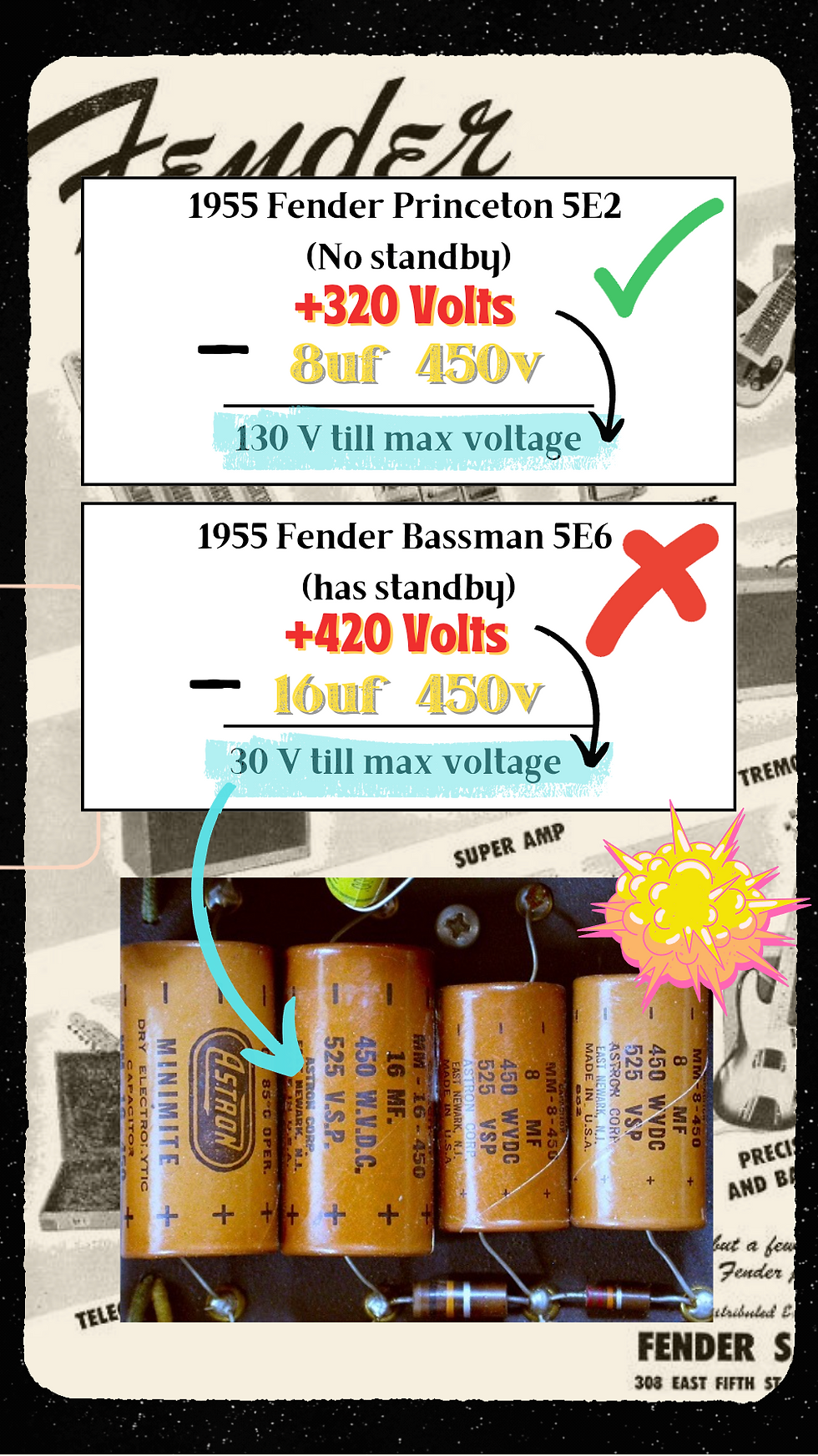
If we take another look at the voltage rating of the caps found in the Princeton and Bassman we can see that the Princetons caps have 130V till they reach max voltage, while the Bassman caps only have 30V till max voltage. The chances of voltage in power supply of the Princeton raising 130V while the tubes begin to warm up and conduct is not very likely. How ever the chances of the voltage in the power supply of the Bassman rising 30V while the tubes warm up and begin to conduct is extremely high. This means that voltage rating of the capacitors will be exceeded, this can result in damage to the cap, the cap failing, or even exploding!

But we also need to remember that the tubes in a guitar amp relatively dont need a lot of time to warm up, so if we were to flip a amp on with cold tubes we would initially see a spike in the voltage of the power supply, this is the point where we can see voltages exceed the voltages listed in the schematic , but as the tube begins to conduct, the power supply then begins to scene a load, resulting in the voltage in the power supply quickly falling before leaving out to the voltage listed on the schematic.
Now if we take a look that the Fender Princeton we can see that when the amp is flipped on there is an initial spike in voltage that will exceed the 320V listed in the schematic, but as the tube begins to conduct this initial spike quickly falls and levels out. Because this amp is operating at a lower voltage, the amp will never be Abel to rise 130V in the time that it takes the tube to start conducting, meaning the voltage rating of the capacitor will never be exceeded. This is why Leo did not install a standby switch on the Princeton.
If we were to flip the Bassman on with cold tubes we would see an initial voltage spike that would exceed the 420v listed in the schematic, the tube would still begin to conduct, and the initial spike would quickly fall, however because this amp is operating at a higher voltage, the install spike in voltage would exceed the voltage rating of the capacitor, which can result in damage to the cap, the cap failing or even exploding.

So what was Leos solution to this problem? The standby switch. We can see here on the schematic the on and off switch, when this is flipped on you are energizing the power transform and rectifier of the amp, if you look down here at the power transform we can see a little note that reads “6.3 volts to filaments and pilot light” this means when you flip the on/off switch to the on position you are sending voltage to the filament of the tube, this is the equivalent to taking the time to build the fire from our example from earlier.
When you have an amp with a standby switch you are supposed to flip the on/off switch, then wait for 10-15 before then flipping the standby switch.
During this 10-15 second waiting period you are giving the filaments, or the fire enough time to heat up the cathode, or the frying pan so it can conduct properly.
Now if we take a look at the standby switch we can see that when in the off position it is disconnecting the high voltage from the caps. After waiting the 10-15 second you can then flip the standby switch, and because the tubes have had plenty of time to warm up they will begin to conduct the second you flip the stand by switch which results in no voltage spike in the power supply, meaning the caps voltage rating will never be exceeded.
I also want to mention something else that can happen when you apply voltage to a cold tubes, and this would be cathode striping. We will save this topic for another day as it is very in depth topic.
Let’s see what you have learned!
Below is a short quiz to test how well you have comprehended the information about standby switches in this article. Your can vote on which answer you believe to be correct by simply clicking on the answer.
True or False: All tubes have the same warm up time
True
False
Answer: False
Warm up time varies drastically depending on the tube. For example this 866-A commonly found in Large radio transmitters like Ham radios do needs upward of 15-20 minutes to work properly, but a 6v6 that is commonly found in guitar amps only needs 11 seconds of warm up to work properly.
In 1943 Leo teamed up with Doc Kaufmann to create what company?
Fenders Repair Service
K&F Manufacturing
Fender Electric Instrument Company
Hiwatt
Answer: K&F Manufacturing
In 1943 Leo teamed up with Doc Kaufmann, a musician and inventor; together they formed K&F Manufacturing, and produced a small variety of lap steel amps during the height of the Hawaiian music craze.
What is the warm up time for a 6V6?
15-20 Minutes
45 Seconds
10 Seconds
11 Seconds
Answer: 11 Seconds
A 6v6 that is commonly found in guitar amps only needs 11 seconds of warm up to work properly.
Fill in the blank : the Bassman 5E6 was the highest voltage amp Leo had released yet, featuring over ____ Volts in the power supply
450 Volts
320 Volts
420 Volts
600 Volts
Answer: 420 Volts
As the demand for more powerful and louder tube amps grew Leo released the Bassman 5E6, this amp was the highest voltage amp Leo had released yet, featuring over 420V in the power supply section.
What is the voltage rating of both the Bassman & Princeton Capacitors?
320 Volts
800 Volts
450 Volts
525 Volts
Answer: 450 Volts
the caps found inside of the Fender Princeton and the Fender Bassman are both rated for 450v. This is the max voltage that the cap can operate at without failing.
In our example from earlier what part of a tube is represented by a frying pan?
The Anode
The Cathode
The Filament
The Electrons
Answer: The Cathode
The cathode, i like to think of this as a frying pan. If we do not give the cathode adequate time to heat up then the electrons or the egg will not cook properly.
Fill in the blank: When you first flip on a amp with cold tubes you will see a initial spike in ______
Voltage
Capacitance
Current
Amps
Answer: Voltage
f we were to flip a amp on with cold tubes we would initially see a spike in the voltage of the power supply, this is the point where we can see voltages exceed the voltages listed in the schematic , but as the tube begins to conduct, the power supply then begins to scene a load, resulting in the voltage in the power supply quickly falling before leaving out to the voltage listed on the schematic.
How do you determine if a Amp needs a standby switch?
Subtract the tube warm up time by the high voltage
Subtract the caps volt rating by the high voltage
Subtract the high voltage by the caps volt rating
Subtract the tube warm up time by the caps volt rating
Answer: Subtract the caps voltage rating by the high voltage
If we subtract the voltage rating of the capacitor by the voltage found in power supply, we can see that the Fender Princeton has 130V till we reach the max voltage of the capacitor. While the Fender Bassman only has 30V till we reach the max voltage rating.
Why does the Bassman need a stand by switch but the Princeton doesn't?
The spike in voltage in the Bassman exceeds the caps rating
The Princeton has pre heated tubes
The Bassman has pre heated tubes
The Princetons tubes do not need time to warm up
Answer: The spike in voltage in the Bassman exceeds the caps rating
If we take another look at the voltage rating of the caps found in the Princeton and Bassman we can see that the Princetons caps have 130V till they reach max voltage, while the Bassman caps only have 30V till max voltage. The chances of voltage in power supply of the Princeton raising 130V while the tubes begin to warm up and conduct is not very likely. How ever the chances of the voltage in the power supply of the Bassman rising 30V while the tubes warm up and begin to conduct is extremely high. This means that voltage rating of the capacitors will be exceeded, this can result in damage to the cap, the cap failing, or even exploding!
Fill in the blank: When you use a standby switch, and give the tubes proper time to warm up you will NOT see a ______ in the power supply?
increase in conductivity
decrease in conductivity
spike in voltage
decrease in voltage
Answer: Spike in voltage
After waiting the 10-15 second you can then flip the standby switch, and because the tubes have had plenty of time to warm up they will begin to conduct the second you flip the stand by switch which results in no voltage spike in the power supply, meaning the caps voltage rating will never be exceeded.
What year did Leo Release the Bassman 5E6?
1948
1975
1946
1955
Answer: 1955
Released in 1955, the very first amp to ever featuring a stand by switch was the Fender Bassman 5E6.These amps were designed by none other that Leo Fender.
What law do we use to determine the relationship between voltage, current and resistance in an electrical circuit?
Newtons second law of motion
Avogadro's law
Ohms law
Law of cosines
Answer: Ohms Law
Using ohms law we know that if there is very low or no current, and high residence, this will result in very high voltage in the power. When this happens , the high voltage listed in the power supply can exceed the number list in the schematic.
Let's Recap!
So now that we know that Leo installed the standby switch to protect the caps from reaching there max voltage rating, as well as protect the tubes from cathode striping, let do a quick recap!
As the demand for more powerful and louder amps grew Leo began designing amps with a-lot higher voltage.
Due to the amp begin ran at a higher voltage the capacitors were also seeing higher voltage, there by lowering the amount of volts till reaching the max voltage rating of the cap.
When tubes are cold they can not conduct properly, this results in little to know current draw causing the power supply to see an open/no load circuit. This can result in power supply voltages rising above the voltages listed in the schematic.
Tubes found in guitar amps have a relatively low warm up time, so when you flip a amp on with cold tubes you will see a initial spike in power supply voltages, but as the tube quickly warms up and begins to conducting, the voltage will quickly fall back down and level out.
In some amps this is fine because the volts till the max cap voltage is so high the initial spike in voltage will never exceed the voltage rating of the cap.
In some amps that use higher voltage, the volts till max cap voltage is very low, this means that the initial spike in power supply voltages can exceed the caps voltage rating, this can result in the cap failing or even worse exploding!
To fix this issue Leo installed a ON/OFF switch that when flipped, sends 6.3 volts to the filaments of the tubes that then warm the cathode of the tube, allowing the tubes time to properly warm up. After waiting 10-15 seconds you then flip the standby switch that then supplies voltage to the rest of the amp. Because the tubes have been given proper time to warm up they are able to conduct properly instantly, this results in no voltage spikes in the power supply thereby the caps will never exceed there voltage rating !
Prefer video format? We got you!
Prefer videos instead of articles? We got you! click the link below to watch the video version of this article!

Comments